How to get your business recommended by ChatGPT, Gemini and Google AI Mode
When someone asks an AI assistant for a recommendation, it has to find you and then choose you. Here is what each of those steps depends on, why llms.txt is not the answer, and how to test where you stand.
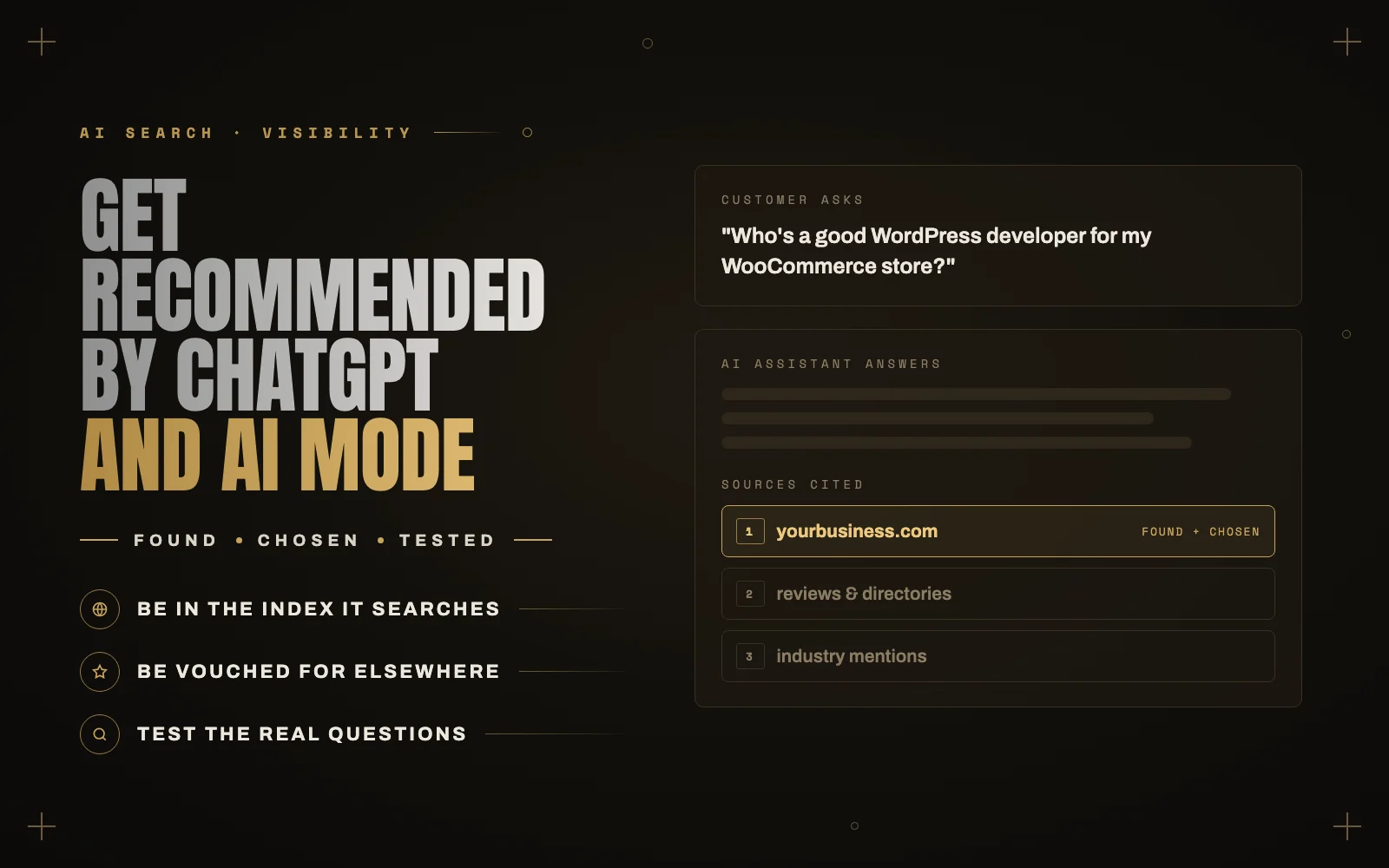
A client asked me last month why ChatGPT recommends their competitor every time someone asks for a provider in their city. The competitor’s site is not better. Their prices are not lower. They are simply easier for an AI assistant to find and easier for it to trust.
That question is now one of the most common things people search for about their own business, and most of the answers online are either vague or selling a tool. So here is how it actually works, as far as anyone outside these companies can tell, and what you can do about it.
Two gates: being found, then being chosen
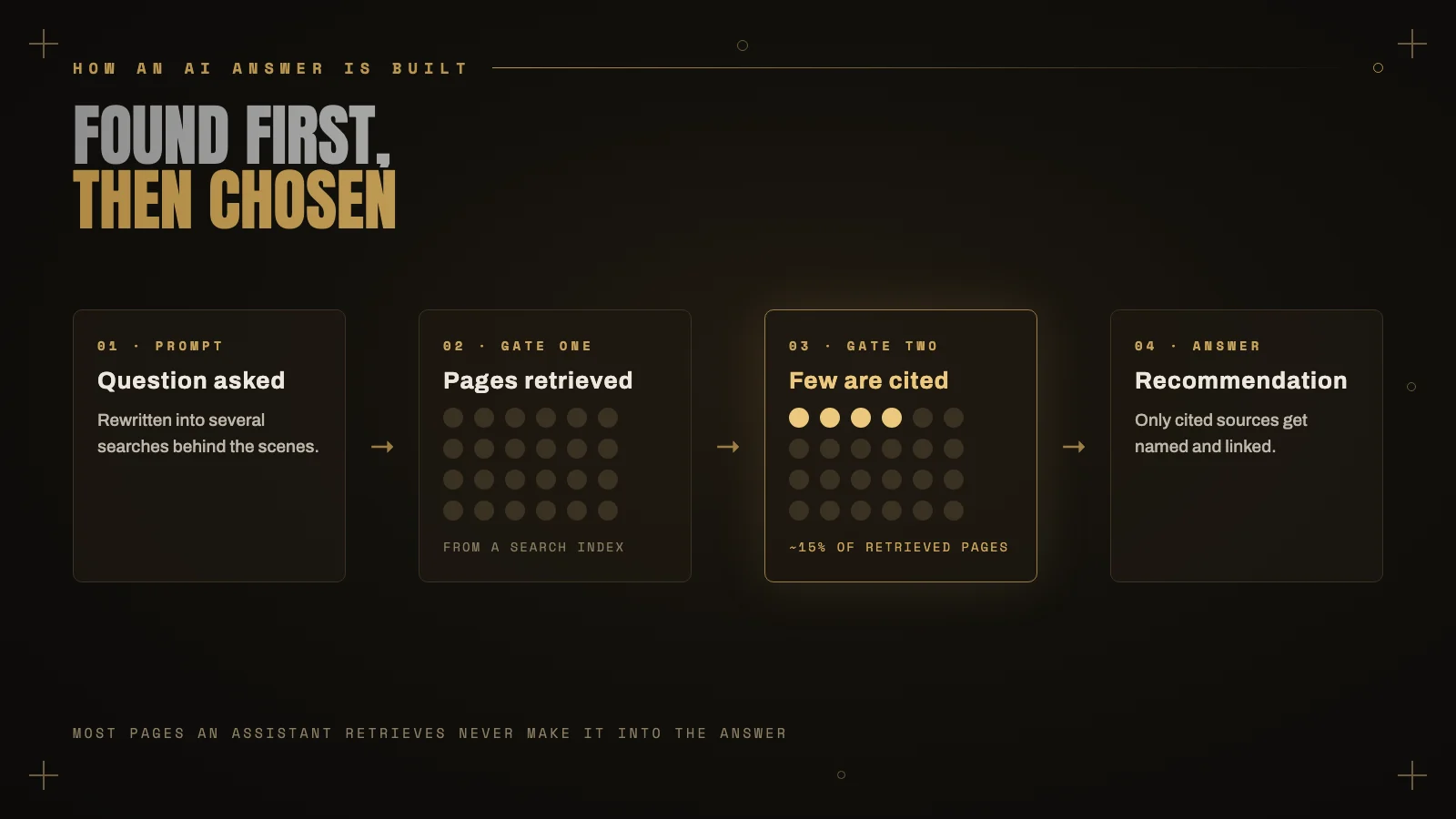
When an assistant like ChatGPT decides a question needs current information, it does not consult some private list of businesses. It rewrites your question into a few searches, pulls candidate pages from a search index, reads them, and then cites a small number of them in the answer.
That gives you two separate problems:
- Being found. If your pages are not in the index the assistant searches, nothing else matters.
- Being chosen. Being retrieved is not enough. One large study by AirOps, covering more than half a million pages, found ChatGPT cited only around 15 percent of the pages it retrieved.
Gate one: make sure you can be found
Do not ignore Bing
Google’s AI Overviews and AI Mode use Google’s index. ChatGPT’s search leans heavily on Bing’s. Plenty of sites that are perfectly healthy in Google have never been checked in Bing at all.
Set up Bing Webmaster Tools, which takes a few minutes if you already use Search Console because it can import your verification, and submit your sitemap. Many SEO plugins can also ping Bing through IndexNow whenever you publish or update a page, which gets changes picked up faster.
Check you are not blocking the wrong crawlers
AI companies run separate crawlers for separate jobs, and it is easy to block one while meaning to block another. OpenAI uses GPTBot for collecting training data and OAI-SearchBot for its search results. Blocking GPTBot keeps your content out of training; blocking OAI-SearchBot keeps you out of ChatGPT’s answers. Those are very different decisions, so check your robots.txt and any security or firewall plugin that blocks bots on your behalf.
Make sure the content is actually in the page
Some themes and page builders load the important content with JavaScript after the page arrives. Many AI crawlers do not run JavaScript the way a browser does, so they see an empty page. View the source of your key pages, not the rendered version, and check that your services, location and prices are there as text.
Gate two: give it a reason to choose you
Say clearly who you are, what you do and where
Assistants are answering questions like “who is a good WordPress developer for a WooCommerce store in my city”. The pages that get cited answer that kind of question plainly: what you do, who it is for, where you work, roughly what it costs and how to get in touch. If a human has to read three paragraphs of brand language to work out what you sell, an assistant will move on too.
Be mentioned somewhere other than your own site
This is the part most businesses skip. Assistants lean toward sources that other sources agree with. Reviews on Google and industry platforms, listings in respected directories, mentions in local press, a case study a client published, honest answers in the communities your customers actually use. Your own site saying you are excellent counts for much less than three independent places saying it.
Keep important pages current
Several studies of AI citations have found recently updated pages are cited more often than stale ones. That does not mean changing the date on a page from 2022. It means reviewing your key pages a few times a year and actually updating prices, examples and screenshots when they change.
An assistant cannot recommend what it cannot find, and it will not recommend what nobody else vouches for.
What about llms.txt?
llms.txt is a plain text file that summarizes your site for language models, and a lot of agencies are currently selling it as the way into AI answers. The evidence says otherwise.
- Google’s John Mueller has said that no AI system currently uses it, and compared it to the old keywords meta tag.
- Google’s own guidance says you do not need new machine readable files, AI text files or special markup to appear in AI Overviews or AI Mode.
- SE Ranking analyzed around 300,000 domains and found no relationship between having the file and being cited.
This site has an llms.txt file, generated by my SEO plugin. It costs nothing and does no harm, which is the most honest thing I can say about it. If someone is charging you for one as an AI visibility strategy, ask them for the evidence.
Test where you stand
You do not need a tool for this. Write down the five questions a customer would actually ask before hiring someone like you. Ask each one in ChatGPT, Gemini and Google’s AI Mode, from a logged out browser, and note who gets mentioned and which pages are cited.
Then look at the businesses that come up. Where are they mentioned? What do their cited pages say that yours do not? That comparison usually tells you more than any report. Repeat it monthly, because the answers change.
The short version
- Get your site into Bing Webmaster Tools and submit your sitemap.
- Check robots.txt and security plugins are not blocking search crawlers.
- Make sure key content is in the HTML, not loaded later by JavaScript.
- Rewrite service pages to answer who, what, where and how much plainly.
- Earn mentions and reviews on sites you do not own.
- Test the real questions monthly and write down what changes.
If AI assistants are recommending your competitors and you want to know why, I can look at your site the way these systems do and tell you what is in the way. Get in touch with the questions your customers ask, and I will start there. For the wider picture, here is what AI answers are doing to search traffic in general.