What a custom WordPress theme actually costs, and when you should not buy one
Page count is not what moves the price. Here is what actually does, the ranges I work in, the cases where a marketplace theme is the right answer, and how to brief developers so three quotes are comparable.
“How much for a WordPress website?” is a question with no honest single answer, in the same way “how much for a car?” has no single answer. But there is an honest way to explain what moves the number, and what you get for each step up.
Here is how I think about it, including the cases where I tell people not to hire me.
Three routes, and what each really costs
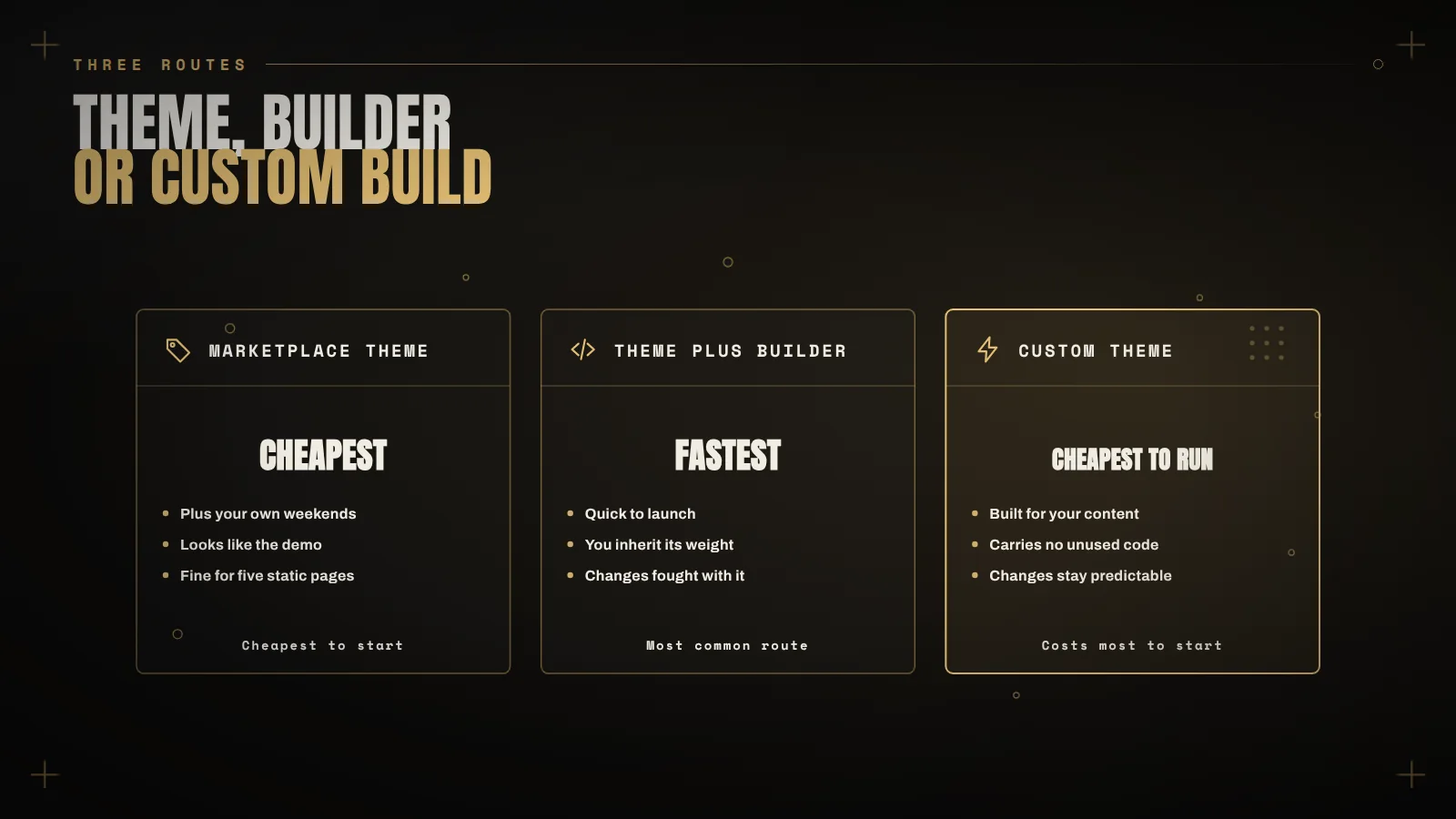
A marketplace theme you set up yourself. Sixty dollars for the theme and your own weekends. The theme will look like the demo until you put your own content in it, and then you will spend those weekends finding out which settings do nothing. Real cost: the licence plus however you value your time.
A premium theme or page builder, customised by a developer. You are paying someone to work within a system that someone else designed. Faster to launch and cheaper upfront. The trade off is that you inherit that system’s weight and its limits, and every future change is negotiated with it.
A custom theme. The templates are written for your content, so the site carries no code it does not need. It is the most expensive way to start and usually the cheapest way to run, because changes are small and predictable instead of fights with a builder.
What actually moves the price
Not the number of pages. Fifty pages that share one template cost less than five pages that are all different. What moves the number is this:
- How many genuinely different templates the site needs. Home, a listing, a detail page, an article, a contact page is five. Every truly unique layout after that is real work.
- How your content is structured. Giving the editor proper fields for each piece of information, rather than one big text box, takes longer to build and saves years of formatting pain afterwards.
- Integrations. A CRM, a booking system, a payment gateway, an inventory feed. Each one is another system whose behaviour you do not control.
- Performance targets. “It should feel fast” is different from “it must pass Core Web Vitals on a mid range Android phone”, and the second one costs more because it has to be measured and defended.
- Content migration. Moving four hundred posts with their images, categories and old URLs redirected properly is a project in itself, and it is the line most quotes quietly leave out.
- Who writes the content. Projects rarely stall on code. They stall waiting for the About page text.

The ranges I work in
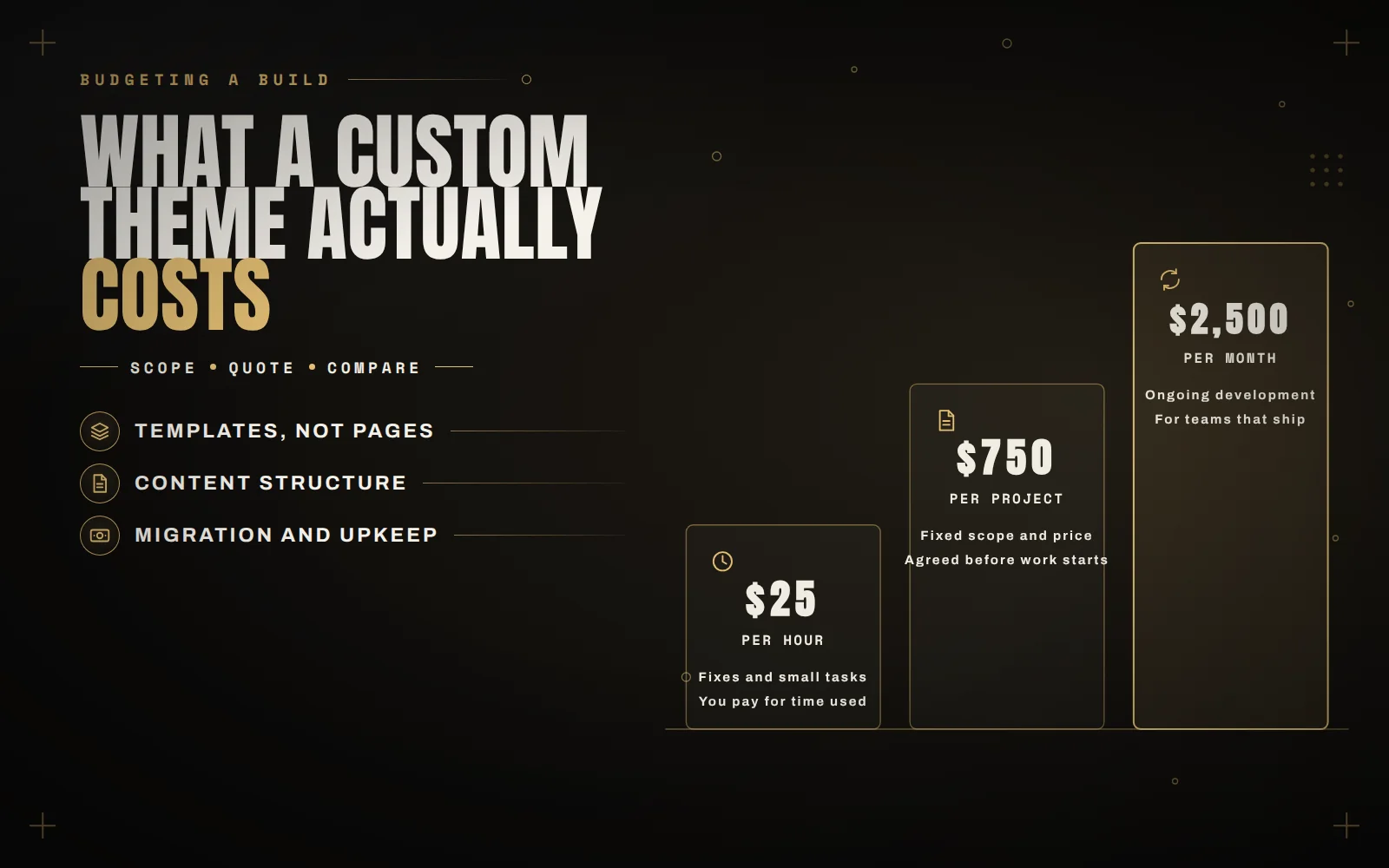
- Hourly, from $25. Fixes, tweaks, frontend bugs, a stubborn layout. Right when the work is small and clearly bounded.
- Project based, from $750. A scoped build with a fixed price and a delivery date, agreed before anything starts.
- Monthly retainer, $2,500. For teams that ship continuously and need development capacity rather than a one off project.
A brochure site with a handful of templates sits near the bottom of the project range. A store with custom product logic, or a site with a real content model behind it, sits well above it. I would rather tell you that in the first email than discover it in week three.
When you should not pay for custom
Some honest cases where a marketplace theme is the correct decision:
- You are still testing the idea. Validate first. Build properly once you know people want it.
- The site is five pages and will stay five pages. A good theme, set up carefully, is genuinely fine.
- The budget covers the build but nothing else. A custom site with no budget left for content, photography or maintenance is worse than a modest site with all three.
When custom pays for itself
It pays when the site is doing a job: when it is the main way customers find and judge you, when speed is a business problem rather than a vanity metric, when people who are not developers update it daily, or when the builder you are on has started deciding what you are allowed to change.
The clearest signal is a sentence I hear often: “we wanted to change X but our developer said the theme cannot do it.” That is the moment the cheap route stopped being cheap.
The costs people forget
- Hosting that can actually serve your traffic, which is not the cheapest plan on the page.
- Annual licences for plugins the site depends on, which do not stop mattering after year one.
- Maintenance. Updates, backups, and someone who answers the phone when a payment gateway changes its API.
- Content. Photography and copy are usually what separate a site that converts from one that merely exists.
How to brief a developer so quotes are comparable
If three quotes come back wildly different, it usually means three people imagined three different projects. Send all of them the same short brief:
- What the site is for, in one sentence, and how you will know it worked.
- The list of page types, not the list of pages.
- Anything it must connect to.
- Who will update it after launch, and how technical they are.
- Whether content and photography exist yet.
- Your budget range. Withholding it does not get you a better price, it gets you a quote for a project nobody has scoped.
Then compare what each quote includes rather than the totals. Revisions, migration, testing and a handover call are the four things that quietly separate a cheap quote from a complete one.
If you want a straight answer about which route your project needs, describe it to me. Sometimes the answer is a custom build. Sometimes it is a good theme and a weekend, and I will tell you that too.
Keep reading
 Plugins
How to remove image backgrounds without leaving WordPress
The slow part of removing backgrounds is not the editing, it is the download and re-upload round trip. Here is how to… Read article ↗ WooCommerce